TLDR: KPIs tell you how a metric is trending right now. OKRs tell you what you’re trying to achieve, and by when. Marketing teams that only track one or the other tend to either drown in dashboards with no direction, or set goals with no way to prove they’re working.
What are KPIs (Key performance indicators)?
KPIs are the ongoing metrics you track over time to answer one question: is this thing going up, or going down? A KPI doesn’t tell you where you’re trying to get to. It tells you where you are right now, compared to where you’ve been.
Take ROAS, tracking it tells you whether your return on ad spend is improving or slipping month to month. It doesn’t tell you whether 4x ROAS is good enough for your business, that context has to come from somewhere else.
Common marketing KPIs include ad spend, impressions, CTR, CPC, conversion rate, ROAS, CPA, sessions, bounce rate, and engagement rate, the kind of metrics that update constantly and answer specific, contained questions like “what’s our CTR by channel?” or “which campaigns have the best conversion rate?”
What are OKRs (Objectives and key results)?
OKRs work differently. Instead of asking “where am I, where have I been,” an OKR asks “where do I want to get to, and how will I know when I’ve got there?”
An Objective is the big, ambitious goal, often deliberately optimistic, and tied to a wider business priority. A Key Result is the measurable proof that you’re moving toward it.
Unlike KPIs, OKRs aren’t something you check daily. They’re set quarterly (or longer). Constantly revising an OKR undermines the point of it, it’s meant to be a fixed target you’re working toward, not a number that changes with every reporting cycle.
OKRs vs KPIs: What’s the difference?
The simplest way to separate the two: KPIs tell you if something is performing as expected. OKRs tell you what you’re trying to achieve, and whether you’ve achieved it.
They’re not meant to be interchangeable, and they’re not competing for the same job, they complement each other. A few core differences:
- Timeframe – KPIs are tracked continuously. OKRs are typically set quarterly.
- Purpose – KPIs monitor performance. OKRs define ambition.
- Precision – KPIs are specific and easy to ask for (“show me impressions by channel this week”). OKRs are broader and need more context before they can be measured, an Objective like “become the most efficient acquisition channel” only means something once you’ve defined what “efficient” means for your business.
- Flexibility – KPIs should be reviewed constantly. OKRs are meant to stay stable across the quarter.
KPIs alone will tell you what’s happening, but not what to prioritize. OKRs alone tell you what to prioritize, but on their own are too vague to track. An Objective like “become more efficient” doesn’tmean anything until it’s broken down into Key Results with real data behind it.
OKR vs KPI examples in marketing
Using ASK BOSCO®’s Cross Channel dataset, which connects Google Ads, Meta, GA4, and Shopify data in one place.
Here’s what that split looks like in practice.
KPIs you’d track continuously
| KPI | Description | Sample AI Studio prompt |
| Cost / Ad Spend | Total marketing investment | What’s our total ad spend this month? |
| CTR | Clicks ÷ Impressions | What’s our CTR by device? |
| CPA | Cost ÷ Conversions | Show CPA by campaign |
| ROAS | Revenue ÷ Cost | What’s ROAS for each channel? |
| Conversion Rate | Conversions ÷ Sessions or Clicks | Which campaigns have the best conversion rate? |
| Bounce Rate | % of single-page sessions | Which campaigns have high bounce rates? |
| Engagement Rate | % of engaged sessions | Compare engagement rate by device |
OKRs you’d set quarterly, and track against those KPIs
Objective 1: maximize marketing efficiency
- Reduce CPA by 15%
- Achieve ROAS > 4x
Objective 2: Grow revenue from paid channels
- Increase conversion value by 25%
- Grow orders from Meta by 20%
Objective 3: Improve traffic quality
- Increase engagement rate to 60%
- Reduce bounce rate below 40%
- Grow session duration by 20%
Every result above is a KPI with a target and a timeframe attached. “Reduce CPA by 15%” only works as an OKR because CPA is already a KPI you’re tracking every week.
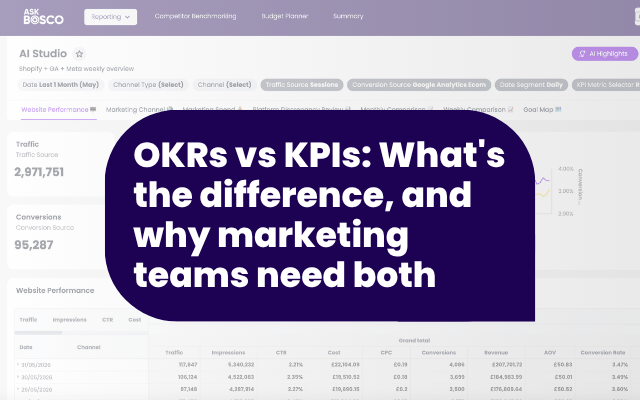
Prompting AI Studio for an OKR update takes more context than prompting for a KPI, because you’re asking it to judge progress against a goal, not just report a number. The more detailed you are about how the Objective is defined and measured, the better the answer back. AI Studio can report on KPIs and OKRs side by side, so you can see the day-to-day number and the quarterly goal in the same view.
This works the same way whether you’re managing it through the main ASK BOSCO® platform or the ASK BOSCO® app inside Shopify, reporting, drill-downs, and change analysis are identical either way, so a Shopify merchant gets the same KPI-to-OKR visibility without leaving their Shopify admin.
Why the difference between OKRs and KPIs matters
Used together, KPIs give you the evidence and OKRs give you the destination. That’s the whole reason ASK BOSCO®’s Cross Channel dataset is built to hold both at once. Connecting Google Ads, Meta, GA4, and Shopify data means a marketing team isn’t choosing between tracking performance and tracking progress toward a goal.