
TLDR: SERP analysis is the process of analyzing what currently ranks on Google for a specific keyword and understanding why. It helps brands uncover search intent, identify real competitors, assess ranking feasibility, and shape content that aligns with what Google is already rewarding. When done properly, SERP analysis turns guesswork into strategy and ensures you’re creating content that actually has a chance to rank.
What is SERP analysis?
SERP analysis is the process of analyzing the Search Engine Results Page (SERP) for a specific keyword to understand what Google is currently ranking and why. In simple terms, it’sabout looking at the results already winning visibility and using them as a blueprint for what your own content needs to do in order to compete.
When you search for a keyword on Google, the page you see, including organic listings, maps, featured snippets, videos, and “People Also Ask” boxes, is the SERP. Analyzing this page allows you to understand Google’s current interpretation of search intent, the type of content it prefers, and the level of competition you’re up against.
SERP analysis is about understanding what Google believes best answers the user’s query and then deciding how your brand can meet and ideally exceed that standard.
SERP analysis vs keyword research vs competitor analysis
SERP analysis often gets confused with keyword research and competitor analysis, but while they’re closely connected, they serve different purposes.
Keyword research is the process of identifying which terms you want (and are able) to rank for. It’s the foundation. Without knowing your target keywords, you can’t perform a meaningful SERP analysis.
SERP analysis comes next. Once you’ve selected a keyword, SERP analysis helps you understand how realistic it is to rank, what type of content Google expects, and why certain pages are currently winning.
Competitor analysis then goes deeper, focusing on who those ranking competitors are, how authoritative they are, and what they’re doing differently to you. Interestingly, SERP analysis often reveals competitors you wouldn’t normally consider competitors at all, especially in SEO. A small independent retailer might not view global brands as direct competitors, but on the SERP, they often are. SERP analysis is where that reality becomes visible.
Why SERP analysis matters
SERP analysis matters because it removes assumptions from SEO decision-making. One of the biggest benefits is understanding search intent. By analyzing what Google already ranks, you can determine whether users are looking to buy, compare, learn, or research and therefore what type of content you should be creating. Trying to rank a blog post where Google is clearly favouring product pages is a losing battle.
SERP analysis also helps brands assess feasibility. If the first page is dominated by huge, authoritative brands, it may not be the right primary keyword for you, at least not yet. That insight can save significant time and resource and often leads brands back to smarter long-tail keyword opportunities where they can realistically compete. Crucially, SERP analysis ensures your content strategy is aligned with reality, not just ambition.
Step-by-step guide to doing a SERP analysis
Define your target keywords
SERP analysis starts with knowing exactly which keyword you are analysing. Unlike keyword research, which often looks at hundreds or thousands of terms, SERP analysis should be highly focused.
You’re typically analyzing one primary keyword (or a tight cluster) at a time. This level of focus is important because SERPs vary dramatically by intent, competition, and layout, even between very similar keywords. Once the keyword is defined, everything else in your analysis becomes clearer.
Analyze the top results
The next step is to analyze what’s ranking on the first page of Google. While this used to mean ten organic listings, modern SERPs often include fewer traditional results due to additionalfeatures.
At this stage, you’re looking for patterns. Are the results informational blogs, category pages, or product listings? Are they long-form guides or short, concise answers? Are videos ranking prominently?
This analysis gives you a strong indication of what Google believes best satisfies the query. If the top results are long, in-depth articles, a short page is unlikely to compete. Equally, if concise pages or video-led content are ranking, length alone won’t be the differentiator.
Examine SERP features
SERP analysis isn’t just about your organic listings. Modern SERPs often include additional features that reveal even more about intent and opportunity. These might include “People Also Ask” boxes, map packs, video carousels, image results, or social content. Each of these features tells you something about how users want information delivered.
If Google is surfacing videos or FAQs prominently, your content strategy should reflect that. Ignoring SERP features often means ignoring some of the strongest ranking signals available.
Evaluate competitor strategies
Once you understand what content is ranking, the next step is evaluating who is ranking and why. This is where SERP analysis naturally overlaps with competitor analysis.
You’ll want to assess competitor authority, content depth, structure, and optimization. In many cases, authority alone can explain why certain pages rank, especially when large brands dominate a SERP. This evaluation helps you determine whether the opportunity is viable now, requires longer-term authority building, or is better approached through alternative keywords.
Extract insights & take action
The final and most important step is turning insight into action. SERP analysis should result in a clear content plan. This might include deciding what type of page to create, how comprehensive it needs to be, what questions it should answer, and how it can genuinely improve on what already exists.
The goal isn’t just to match competitors, but to understand how you can deliver a better, more useful experience for users while staying aligned with what Google already rewards.
Key tools for SERP analysis
There are several tools that support SERP analysis, including platforms like Ahrefs and SEMrush, which allow you to preview SERPs, analyse ranking pages, and assess authority metrics. However, tools should never replace manual analysis, especially because SERPs vary by location and user context.
It’s often valuable to manually check SERPs from different locations to understand how results change geographically, particularly for local or service-based businesses.
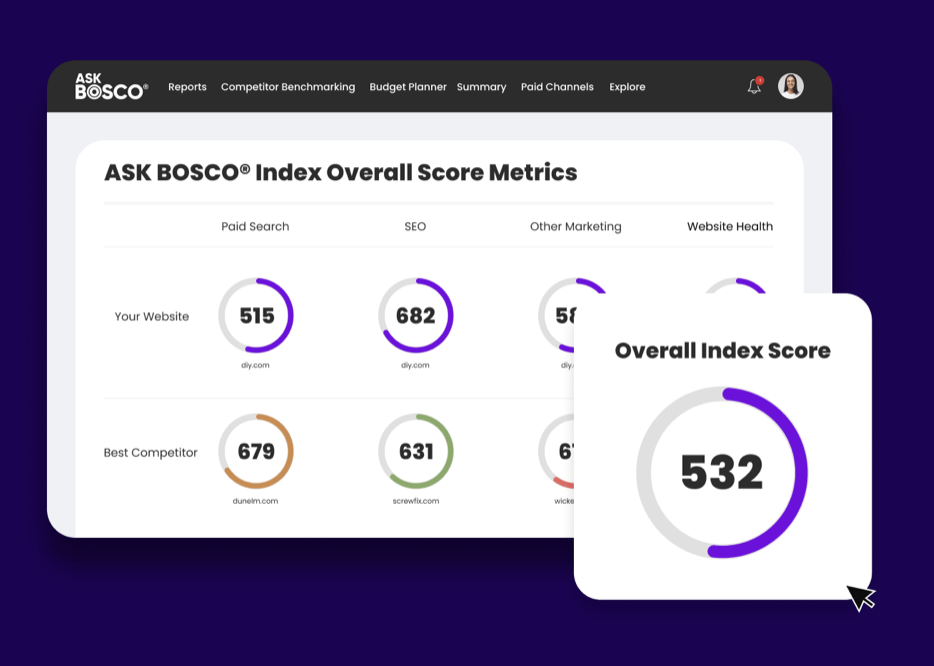
ASK BOSCO®’s Competitor Benchmarking feature provides a strong supporting layer to your SERP analysis work. Once you’ve identified which domains are consistently appearing on the SERP for your target keywords, you can add those competitors into ASK BOSCO® to benchmark performance at a domain level.
This allows you to compare SEO performance, authority signals, and overall visibility against the competitors that are actually winning space on the SERP, rather than those you might assume are competitors from a purely commercial perspective. Used alongside manual SERP analysis, competitor benchmarking helps validate feasibility, highlight gaps, and track progress against the brands that matter most in organic search.
Conclusion
SERP analysis is one of the most important, and most overlooked steps in SEO strategy. It bridges the gap between keyword research and content creation, ensuring that what you produce is aligned with real-world search behaviour and competition.
By analyzing intent, competitors, content formats, and SERP features, brands can stop guessing and start making informed decisions that lead to sustainable rankings. Whether you’recreating new content or optimising existing pages, SERP analysis ensures every effort is grounded in how Google actually works today