TLDR: Conversion APIs are server-to-server tracking solutions that send conversion data directly from your website to advertising platforms like Meta, Google, TikTok, and Snapchat. Unlike pixels, they don’t rely on browser cookies, making them more resilient to ad blockers, privacy settings, and iOS restrictions. While Conversion APIs provide more accurateconversion data, pixels still capture richer behavioural signals. The strongest setup uses both together, allowing platforms to deduplicate events and maximize performance, often improving results by 20–30% once implemented correctly
What is a conversion API?
A conversion API is a server-to-server tracking solution that allows your website to send conversion data directly to an advertising platform.
In simple terms, instead of relying on a user’s browser to send information back via cookies (as pixels do), a conversion API enables your website’s server to communicate directly with platforms like Meta or Google. When someone completes an action such as a purchase, lead submission, or page view, that information is passed straight from your site to the platform without relying on browser-based tracking. This direct connection removes many of the common issues associated with browser tracking, such as blocked cookies, privacy settings, or ad blockers.
How conversion APIs work
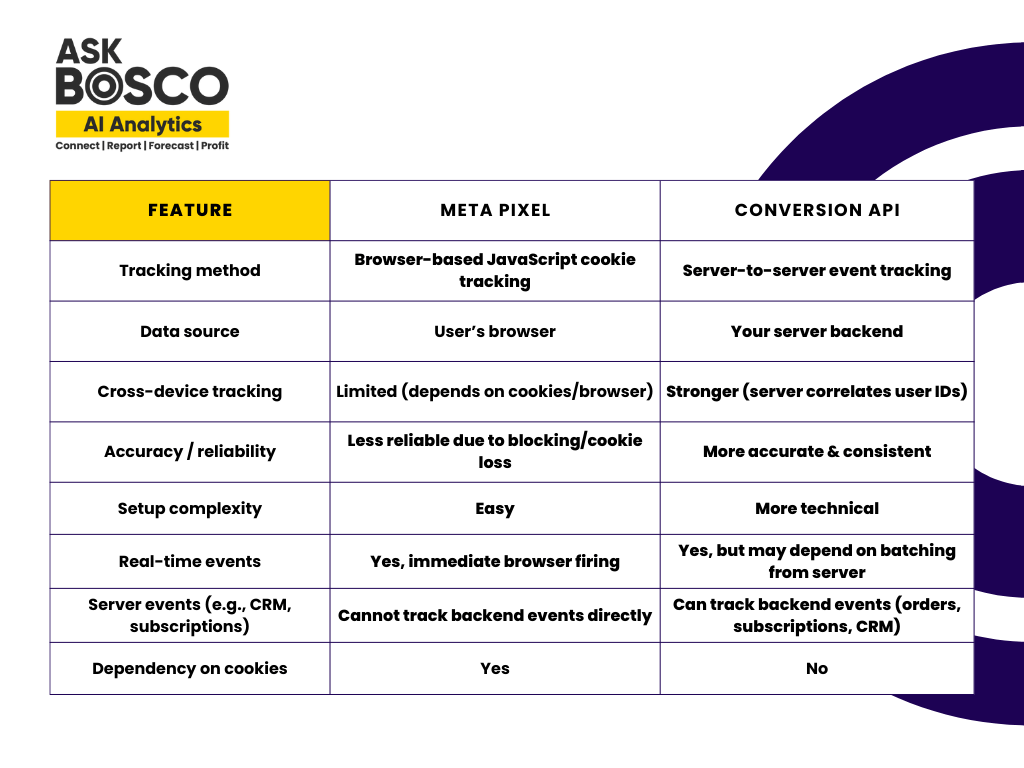
At a high level, conversion APIs work by removing the “middleman”, by this we mean the browser. Traditionally, when a user completes an action on a website, a pixel stored in the browser sends that data back to an advertising platform. This relies on cookies and user-side permissions. Conversion APIs work differently.
When a user completes an action:
- The website records the event on the server
- The server sends that conversion data directly to the advertising platform
- The platform receives confirmed conversion data without relying on cookies or browser storage
For example, with Meta’s Conversion API, your website directly sends information such as page views or purchases straight to Meta’s servers. There’s no reliance on data stored on the user’s device, which makes the data more reliable and consistent.
Benefits of using conversion APIs
As browser become more privacy-first focused, conversion APIs offer several key benefits:
Less impact from privacy restrictions
Conversion APIs are far less affected by:
- Cookie blocking
- Ad blockers
- Users clearing browser data
- iOS tracking limitations
Because the data is sent server-to-server, it’s more likely to reach the advertising platform accurately.
More accurate conversion data
Conversion APIs tend to provide cleaner and more accurate conversion reporting, as they track confirmed on-site actions rather than relying on browser-side assumptions.
Improved campaign performance
When implemented for clients that previously relied only on pixels, conversion APIs can significantly improve performance. In many cases, advertisers see performance improvements of 20–30%, simply due to platforms receiving better conversion signals.
Stronger platform optimization
More reliable data helps advertising platforms optimise campaigns more effectively, improving bidding, targeting, and delivery decisions.
Major platform conversion APIs explained
While each platform brands its solution slightly differently, they all function in largely the same way, sending conversion data directly from your server to the platform.
Meta conversion API
Meta’s conversion API works alongside the Meta Pixel to improve tracking accuracy. It allows advertisers to monitor match rates, deduplicate events, and validate data quality directly inside Meta Events Manager.
Google Enhanced Conversions
Google’s Enhanced Conversions for Google Ads improves data matching but is not a full cAPI solution like Meta’s. Instead, you will need to utilise GTM or GA4 to have a full server to server approach.
TikTok Events API
TikTok’s Events API functions similarly, improving attribution and optimization for conversions that may otherwise be lost due to browser restrictions.
Pinterest & Snapchat conversion APIs
Both platforms offer server-side conversion tracking to enhance attribution accuracy and campaign performance, particularly for ecommerce advertisers.
For ecommerce brands, especially those using Shopify, setup across most platforms is extremely straightforward, often requiring only official plugins rather than custom development.
Facebook conversion APIs vs. Pixel tracking
While Conversion APIs are more accurate, that doesn’t mean pixels are obsolete. In fact, the strongest setup uses both together.
Pixels are browser-based and can pass back richer behavioural signals, such as:
- Browsing behaviour
- Audience signals
- Impression views
- Activity across other sites
Conversion APIs, on the other hand, focus on confirmed on-site actions and are less impacted by privacy blockers. When both are installed correctly, they deduplicate events, ensuring conversions aren’t double-counted while maximising data quality. Best practice today is not choosing between pixel and conversion API, it’s using both together.
Best practices of conversion APIs
Best practice is to always use conversion APIs alongside pixels, rather than treating them as a replacement. While pixels are able to capture richer behavioural signals such as browsing habits and audience signals, conversion APIs provide greater accuracy and resilience by sending confirmed conversion data directly from the server. Used together, they complement one another and ensure platforms receive the strongest possible data set.
Conversion APIs should also be set up for every advertising platform you actively use. Whether you’re running campaigns on Meta, Google, TikTok, Snapchat, or Pinterest, enabling each platform’s conversion API brings clear benefits and no real downside. In most cases, this simply results in improved data quality and more reliable campaign optimization.
Once installed, it’s important to review platform diagnostics to ensure everything is working as expected. Most platforms provide tools to check match rates, data quality, and any errors or missing events. Reviewing these shortly after setup allows you to quickly identify and resolve issues before they impact performance.
Where possible, native integrations should be used to simplify setup and reduce the risk of errors. For ecommerce brands, especially those using platforms like Shopify, official plugins make it easy to implement conversion APIs correctly without the need for complex development work.
Finally, while tools like GA4 and ASK BOSCO® remain valuable, it’s important to monitor platform data directly. Conversion API data lives within the advertising platforms themselves, and once enabled, this data typically becomes far more accurate. Relying solely on GA4 can mask these improvements, so reviewing platform reporting is key to understanding the full impact of conversion APIs.
Conclusion
Conversion APIs are essential for reliably tracking your data. By sending conversion data directly from your server to advertising platforms, you overcome many of the limitations of traditional browser-based tracking.
However, conversion APIs work best alongside pixels. Together, they provide the most complete, accurate, and actionable data possible, helping platforms optimize campaigns more effectively and drive measurable performance gains. For advertisers willing to implement them properly, conversion APIs offer low risk, high reward, and a clear path to a stronger campaign performance moving forward.